Wednesday, January 7, 2026

Can you feel the Schumann Resonance?

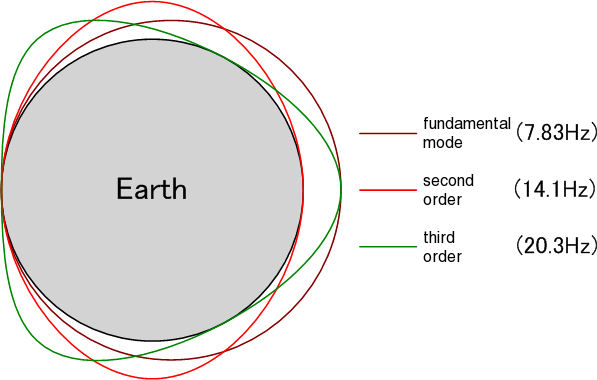
The Schumann resonance is a set of extremely low-frequency electromagnetic vibrations that occur naturally in the space between the Earth’s surface and the ionosphere. You can think of this space as a giant resonant cavity that “rings” electrically, a bit like a bell, whenever it’s excited by lightning strikes around the planet. See the pictures below.

Image

Image


Here’s how it works in simple terms:

Lightning flashes happen constantly worldwide (tens of times per second). Each strike sends out electromagnetic waves. Some of these waves get trapped between the Earth and the ionosphere and bounce around the planet. At certain specific frequencies, the waves reinforce each other instead of cancelling out. These reinforced frequencies are the Schumann resonances.

The fundamental (main) frequency is about 7.83 Hz, with higher harmonics around 14, 20, 26, 33 Hz, and so on. These frequencies are extremely low—far below radio waves—and you cannot hear them as sound.

Why it matters scientifically:

  • It helps scientists study global lightning activity

  • It provides information about the ionosphere’s condition

  • It’s useful in monitoring climate patterns and even solar activity

  • It confirms basic predictions of electromagnetic physics made in the 1950s

  • Human brainwaves (especially alpha waves) happen to fall in a similar frequency range (around 8–12 Hz)

  • This has led to claims that Schumann resonance directly affects consciousness, mood, or health

  • The field strength of Schumann resonance is extremely weak, far weaker than everyday electromagnetic exposure

In short:

  • Schumann resonance is real and well-established physics

  • It’s caused by lightning interacting with Earth’s atmosphere

Tuesday, January 6, 2026

Was Al Bielek telling the truth?

Al Bielek is a figure who occupies a strange and enduring space between conspiracy lore, speculative physics, and personal testimony. He presented himself not as a theorist but as a participant, a man who claimed to have lived through events so extraordinary that they permanently removed him from the boundaries of accepted history. According to his account, he was born in 1927 and lived an apparently ordinary early life, yet beneath that surface lay suppressed memories of secret government experiments involving time travel, mind control, and advanced technology far beyond what the public believes possible.

Central to Bielek’s narrative is the Philadelphia Experiment, an alleged US Navy project during World War II in which the destroyer escort USS Eldridge was rendered invisible using electromagnetic fields. Bielek claimed not only that the experiment occurred, but that he was physically present during its execution in 1943. In his telling, the experiment went catastrophically wrong: sailors were fused into the metal of the ship, others went mad, and some vanished entirely. He stated that he and his brother jumped off the ship during the experiment and were propelled through time, first to the year 1983 and later to 2137. These temporal displacements, he said, exposed him to future technologies, social structures, and catastrophic global events that shaped the rest of his life.

A key feature of Bielek’s story is the idea of memory suppression and later recovery. He maintained that after being returned to the mid-20th century, his memories were deliberately erased using advanced psychological and technological techniques. For decades, he lived without conscious awareness of what had happened, working as an engineer and leading what appeared to be a conventional life. It was only in the late 1980s, he claimed, that his memories were triggered and gradually returned, prompting him to begin speaking publicly about his experiences. This delayed revelation became both a cornerstone of his credibility among supporters and a major point of scepticism among critics.

Bielek’s accounts extended far beyond the Philadelphia Experiment itself. He spoke at length about Project Montauk, an alleged continuation of wartime experiments conducted at Camp Hero on Long Island. According to him, Montauk involved not only time travel but also psychic amplification, mind control, and contact with non-human intelligences. He described children being used as experimental subjects and claimed that the project created rifts in space-time that threatened reality itself. In these narratives, Bielek positioned himself as both witness and reluctant participant, someone who understood the moral horror of what was being done but felt powerless to stop it.

Another striking element of his testimony was his description of the future. Bielek asserted that he had seen timelines in which environmental collapse, authoritarian global governance, and widespread social upheaval dominated the 21st century. He often spoke of multiple timelines, suggesting that the future was not fixed but probabilistic, shaped by human choices. This allowed him to explain why some of his predictions did not unfold exactly as described, while still maintaining the internal coherence of his worldview. For his followers, this flexibility made his warnings more urgent; for critics, it made them unfalsifiable.

Sceptics have pointed out numerous inconsistencies in Bielek’s claims, including discrepancies in dates, technical descriptions that do not align with known physics, and the lack of corroborating evidence from military records. Historians note that the USS Eldridge’s documented movements do not match the Philadelphia Experiment narrative, and physicists argue that the technologies described would require energy levels far beyond what was available in the 1940s. Psychological explanations have also been proposed, ranging from confabulation to the influence of existing science fiction and conspiracy literature on memory formation.

Yet dismissing Bielek purely on factual grounds does not fully explain his lasting influence. His talks, interviews, and recordings resonated with audiences who already sensed that official narratives were incomplete or deceptive. In a late-Cold-War and post-Cold-War context marked by secrecy, black projects, and genuine government deception, his stories felt emotionally plausible even when empirically unsupported. He spoke calmly and methodically, using technical language and a measured tone that contrasted with the more sensational style of many conspiracy figures, which for some listeners enhanced his perceived credibility.

Culturally, Bielek’s work sits at the intersection of science fiction, mistrust of authority, and existential anxiety about the future. His narratives echo themes found in twentieth-century literature and film: the fear that technological progress outpaces moral responsibility, the idea that time itself may be manipulated by those in power, and the suspicion that ordinary people are excluded from truths that fundamentally shape their lives. Whether taken literally or symbolically, his stories function as modern myths, expressing collective concerns about control, memory, and the fragility of reality.

In his later years, Bielek continued to give lectures and interviews, presenting himself as a whistleblower rather than a prophet. He insisted that his purpose was not to frighten but to inform, to encourage critical thinking and resistance to blind acceptance of authority. After his death in 2011, his legacy persisted online, where recordings of his talks circulate alongside debates dissecting every aspect of his claims. To some, he remains a courageous truth-teller who revealed secrets too vast for official acknowledgment. To others, he is an example of how compelling narratives can arise from a mixture of belief, memory, and imagination.

Ultimately, Al Bielek’s significance may lie less in whether his accounts are factually true and more in what they reveal about human psychology and culture. His story demonstrates how personal testimony can challenge established history, how narratives of hidden knowledge gain power in times of uncertainty, and how the boundary between reality and belief is negotiated not only through evidence but through trust, fear, and hope. Whether viewed as a witness to impossible events or as a creator of a modern legend, Bielek remains a fascinating figure in the landscape of contemporary mythmaking.


Saturday, January 3, 2026

The Montauk Project

The Montauk Project occupies a strange space between history, myth, psychological speculation, and modern folklore, rooted in a real place that feels almost designed to invite unease. At the easternmost tip of Long Island lies Camp Hero, a decommissioned Cold War installation dominated by a massive concrete radar tower, its silhouette looming against the Atlantic sky. The wind there is constant, the fog thick and unpredictable, and the land itself feels cut off from the rest of the island, as though geography conspires to make it feel separate from ordinary reality. It is this atmosphere—combined with genuine secrecy surrounding Cold War military programs—that allowed the Montauk Project narrative to take hold and endure.

According to the conspiracy theory known as the Montauk Project, Camp Hero did not simply function as a radar station and coastal defense point. Instead, it allegedly became the site of covert experiments that pushed far beyond conventional science, crossing into mind control, time manipulation, and contact with non-human intelligences. Proponents claim that after the closure of earlier psychological warfare programs, the U.S. government relocated its most extreme research to Montauk, exploiting the base’s isolation and subterranean infrastructure. The theory suggests that beneath the visible surface of the base lay extensive underground laboratories, reinforced corridors, and chambers designed to contain experiments that could not be explained—or acknowledged—within existing scientific frameworks.

Central to these claims is the idea that the Montauk Project continued the work of real, documented programs such as MKUltra, in which the CIA conducted unethical experiments involving hypnosis, psychoactive drugs, sensory deprivation, and behavioral conditioning. In the Montauk narrative, these techniques were refined and amplified using electromagnetic fields generated by the radar equipment at Camp Hero. It is said that the tower itself was repurposed, no longer scanning the skies for Soviet bombers but instead transmitting frequencies capable of influencing human perception, memory, and even consciousness. Survivors allegedly emerged with fragmented recollections, dissociative symptoms, and what they described as “missing time,” reinforcing the belief that memories had been deliberately suppressed or altered.

As the story deepens, it moves further from psychology and into speculative physics. Advocates of the theory claim that Montauk scientists discovered ways to manipulate time itself, creating portals or temporal rifts through which objects—and sometimes people—were sent. These experiments supposedly resulted in individuals being displaced across timelines, returned to childhood versions of themselves, or erased entirely from conventional history. Time, within this narrative, is not linear but malleable, a substance that can be folded, compressed, or torn under the right conditions. The most extreme accounts describe accidental breaches that allowed unknown entities to enter our reality, forcing the abrupt shutdown of the project.

One of the most disturbing elements of the Montauk legend is the recurring figure often referred to as the “Montauk Boy,” a young subject said to possess powerful psychic abilities. According to the story, this individual was used as a conduit, his imagination amplified by machines until thoughts manifested physically. Nightmares allegedly took form, becoming real and dangerous, blurring the boundary between mind and matter. This motif—of imagination made tangible—echoes deep psychological fears about the loss of control over one’s inner world, and it is perhaps no coincidence that such imagery resonates strongly in a culture increasingly aware of trauma and dissociation.

The primary source for much of this narrative is Preston Nichols, who, along with collaborators, published accounts in the early 1990s claiming recovered memories and insider knowledge. Nichols described a life fractured by time jumps, erased recollections, and repeated manipulation, presenting himself both as a victim and a reluctant witness. Critics point out that his claims align closely with known patterns of false memory formation, particularly during periods when public awareness of MKUltra and repressed memory theory was widespread. No documents, photographs, or independent testimonies have ever substantiated his account, yet the emotional intensity of the narrative has allowed it to persist, repeated and reshaped across decades.

What grounds the Montauk Project in public imagination is the undeniable reality of Cold War secrecy. Camp Hero was part of the SAGE air defense system, a genuine network designed to detect Soviet threats, and its closure in 1981 left behind an imposing, decaying structure. The silence surrounding its operations, combined with restricted access and a lack of public explanation, created fertile ground for speculation. Humans are deeply uncomfortable with gaps in narrative, and where information is absent, imagination rushes in to fill the void.

Over time, the Montauk Project has evolved into a modern myth, influencing popular culture and inspiring fictional reinterpretations. The most notable example is Stranger Things, which was originally conceived under the working title “Montauk” and borrowed heavily from the themes of secret experiments, psychic children, and alternate dimensions. In this way, the Montauk narrative has fed back into the collective imagination, reinforcing itself through fiction that feels emotionally true even if factually unverified.

At its core, the Montauk Project reflects a deeper cultural anxiety: fear of unseen authority, mistrust of institutions, and uncertainty about the limits of science. It asks unsettling questions about consent, memory, and identity, and it thrives in the liminal space between what is known and what is suspected. Whether interpreted as a literal conspiracy, a psychological phenomenon, or a form of contemporary mythology, the Montauk Project endures because it speaks to a persistent unease—that there may be forces shaping reality beyond our awareness, and that the truth, if uncovered, might be stranger than fiction.