The Schumann resonance is a set of extremely low-frequency electromagnetic vibrations that occur naturally in the space between the Earth’s surface and the ionosphere. You can think of this space as a giant resonant cavity that “rings” electrically, a bit like a bell, whenever it’s excited by lightning strikes around the planet. See the pictures below.
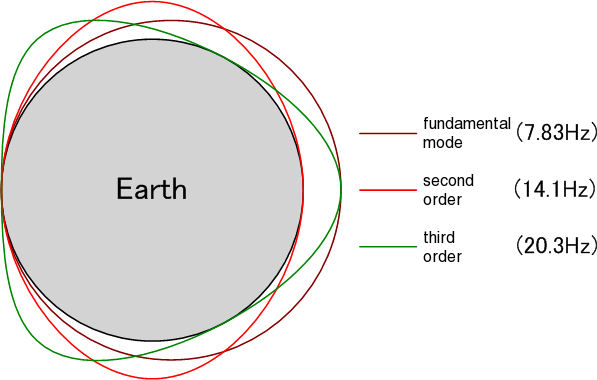

Here’s how it works in simple terms:
Lightning flashes happen constantly worldwide (tens of times per second). Each strike sends out electromagnetic waves. Some of these waves get trapped between the Earth and the ionosphere and bounce around the planet. At certain specific frequencies, the waves reinforce each other instead of cancelling out. These reinforced frequencies are the Schumann resonances.
The fundamental (main) frequency is about 7.83 Hz, with higher harmonics around 14, 20, 26, 33 Hz, and so on. These frequencies are extremely low—far below radio waves—and you cannot hear them as sound.
Why it matters scientifically:
It helps scientists study global lightning activity
It provides information about the ionosphere’s condition
It’s useful in monitoring climate patterns and even solar activity
It confirms basic predictions of electromagnetic physics made in the 1950s
Human brainwaves (especially alpha waves) happen to fall in a similar frequency range (around 8–12 Hz)
This has led to claims that Schumann resonance directly affects consciousness, mood, or health
The field strength of Schumann resonance is extremely weak, far weaker than everyday electromagnetic exposure
In short:
Schumann resonance is real and well-established physics
It’s caused by lightning interacting with Earth’s atmosphere

No comments:
Post a Comment